

In an optical system, getting the right light to the right place is only part of the challenge. Unwanted wavelengths can interfere with measurements, reduce image contrast, or make it difficult for a detector to distinguish useful signals from background light. Even a well-designed system can struggle when the wrong light reaches a sensitive component.
That's where optical filters come in. But what are the different types of optical filters, and how do they affect performance? Understanding how they work helps engineers and original equipment manufacturer (OEM) buyers choose components that meet their application's needs.
How Do Optical Filters Work?
Optical filters control which wavelengths of light pass through an optical system. Depending on their design, they transmit selected wavelengths while absorbing or reflecting others. This allows engineers to isolate useful light without having to change the light source.
Many precision optical filters use thin-film coatings applied to a glass substrate. These coatings contain carefully controlled layers that interact with incoming light to produce specific transmission characteristics. Other filters rely on the natural absorption properties of the glass itself.
A filter's performance is often represented by a transmission curve, which shows how much light passes through at different wavelengths. Engineers use this information to determine whether a filter transmits enough light where it's needed while adequately blocking unwanted wavelengths.
The application ultimately determines what's required. A machine vision system may need to separate illumination from background light, while a laser application may call for much more selective wavelength control.
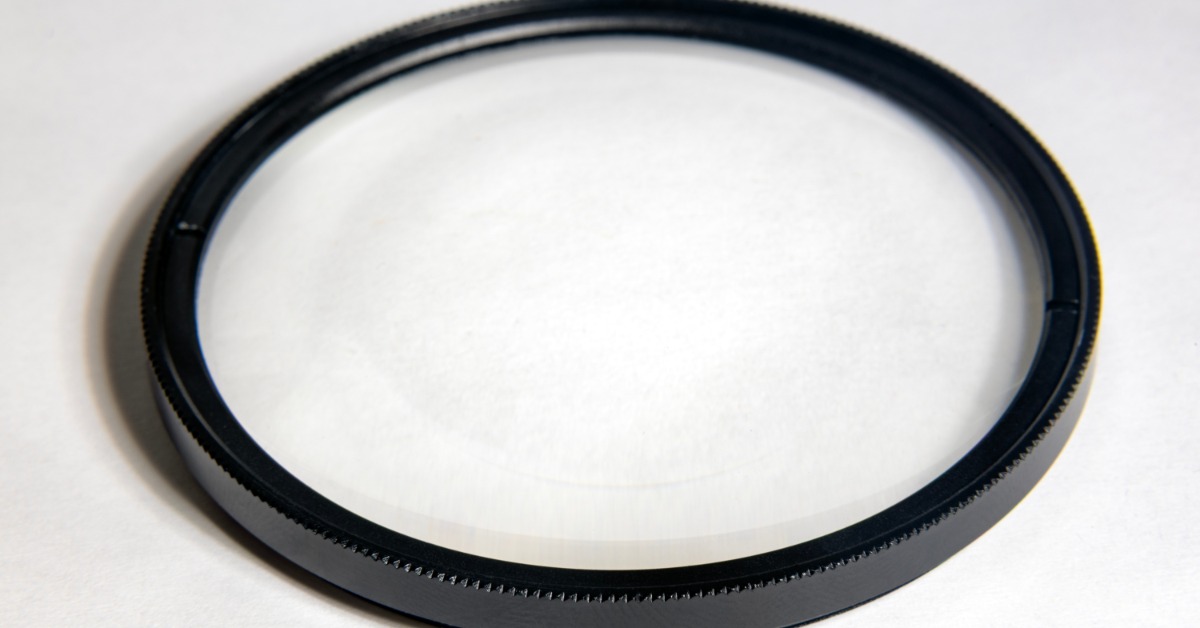
What Are the Main Types of Optical Filters?
As mentioned, not all optical filters control light in the same way. Some isolate a narrow wavelength range, while others allow a broader portion of the spectrum to pass through. Understanding these differences makes it easier to identify which design suits a particular application.
Bandpass Filters
Bandpass filters transmit a defined range of wavelengths while blocking light outside that range. They're especially useful when a system needs to isolate a specific wavelength or a narrow portion of the spectrum.
For example, fluorescence imaging systems may use bandpass filters to separate emitted light from the illumination used to excite a sample. The filter's center wavelength and bandwidth determine which wavelengths reach the detector.
Longpass Filters
Longpass filters transmit wavelengths longer than a specified cutoff while blocking shorter wavelengths. Rather than isolating a narrow band, they allow a broader section of the spectrum to pass through.
These filters are useful when shorter-wavelength light could interfere with a measurement. They can also work alongside other filters to separate different spectral regions within an optical system.
Shortpass Filters
Shortpass filters work in the opposite direction. They transmit wavelengths shorter than a designated cutoff while blocking longer wavelengths.
In imaging applications, this can help prevent unwanted longer-wavelength light from reaching a detector. However, the cutoff wavelength isn't the only consideration. Engineers also need to evaluate how sharply the filter transitions between transmitting and blocking light.
Notch Filters
Notch filters block a relatively narrow wavelength range while transmitting light outside that range. They're useful when one unwanted wavelength needs to be removed without significantly affecting the surrounding spectrum.
Raman spectroscopy provides a good example. A notch filter can suppress excitation laser light while allowing nearby wavelengths carrying measurement information to reach the detector.
Neutral Density Filters
Neutral density filters reduce light intensity across a specified wavelength range without intentionally favoring particular wavelengths. Unlike bandpass or notch filters, their primary purpose is attenuation, or reducing the amount of light that passes through.
They're commonly used when too much light reaches a detector. Reducing that intensity can help manage exposure and prevent saturation.
However, attenuation isn't necessarily identical at every wavelength. It's important to check the filter's specified operating range rather than assume it will perform the same way across the entire spectrum.
What Other Optical Filter Designs Are Available?
Wavelength selection is only one way to control light. Some optical filters use different physical principles to manage transmission or separate optical signals.
Dichroic Filters
Dichroic filters use interference coatings to transmit certain wavelengths while reflecting others. Instead of simply removing unwanted light, they can redirect it along another optical path.
This makes them useful in fluorescence microscopy and systems that handle multiple wavelengths. Their performance can change with the angle of incoming light, so the filter's position within the system matters.
Polarizing Filters
Polarizing filters control light based on polarization, which describes the orientation of its electric field. This differs from spectral filtering, where wavelength determines which light passes through.
These filters can help manage reflections or isolate polarization-dependent signals. They're especially useful in measurement applications where the polarization state affects the information being collected.
Colored Glass Filters
Colored glass filters rely on the material's absorption properties rather than interference coatings to control transmitted wavelengths. The glass absorbs selected portions of the spectrum while allowing others to pass through.
Their performance depends on material composition and thickness. For applications that don't require extremely narrow wavelength selection, colored glass may be a suitable option.
How Do Optical Filters Fit Into Custom Optical Systems?
Optical filters rarely work alone. Their effectiveness depends partly on the light entering them and how surrounding components influence that light.
For example, cylindrical optics can shape a beam differently along two perpendicular axes. Depending on the system geometry, this may influence the angles at which light reaches a downstream filter. Because interference filters can respond differently to angled light, it's important to consider the complete optical path.
Material selection adds another consideration. The substrate must transmit the desired wavelengths while meeting the component's physical requirements. Optical coatings must also be suitable for the intended operating conditions.
Clear specifications make conversations more productive. Engineers should communicate the intended optical function along with relevant drawings and operating conditions. Procurement teams can then use that information to discuss manufacturing requirements and inspection expectations with potential suppliers.
How Can the Right Filter Support Optical Performance?
Choosing the right optical filter isn't simply a matter of blocking unwanted light. The filter also needs to work with the rest of the system so the intended signal reaches the detector.
Whether an application calls for a bandpass filter, a notch filter, or another design, the decision should account for actual operating conditions. Substrate characteristics and physical fit matter just as much as the wavelengths being transmitted.
If you're working on a custom optical component that requires precise glass fabrication or specialized coatings, IRD Glass can help you review the manufacturing requirements. Share your drawing or performance specifications with an IRD Glass expert to discuss material and coating options before moving forward with a quote.